See the scene as geometry
The head and wrist camera images and the instruction go into a 3D foundation model: a backbone built to recover depth, points and camera poses, not pixels or words.
E0.5 takes a 3D foundation model, built to reconstruct the scene in front of it, and teaches it to reconstruct the future: the depth, point maps and cameras of the scene to come. Then it acts on that geometry.
Most world-action models (WAMs) inherit their world knowledge from video generators or vision-language models, so geometry is either implicit or an optional side input. E0.5 takes the opposite route: it is built directly on a 3D foundation model and trains that backbone end-to-end to predict the future 3D state (depth, point maps and camera parameters at the end of the action chunk) jointly with the actions that lead there.
Without any embodied-data pretraining, E0.5 reaches 89.90% success on clean RoboTwin 2.0 scenes and 50.09% on randomized scenes with a 2.32B-parameter policy. Predicting future geometry adds 9.43 points of average success over no reconstruction and 7.93 points over reconstructing the current state. After pretraining on more than 160k AgiBotWorld-Beta trajectories, mean real-world success rises by about 15 points on AgileX Piper and about 7 points on the Zerith H1 humanoid.
The head and wrist camera images and the instruction go into a 3D foundation model: a backbone built to recover depth, points and camera poses, not pixels or words.
The same backbone reconstructs the scene that is about to happen, as depth, point maps and camera poses. This is a training signal only; nothing extra runs at inference.
An action expert reads those geometry features layer by layer and generates the next chunk of robot motion.
Start from a video model or a VLM.
Geometry stays implicit, or is bolted on as an optional extra input.
Start from a 3D foundation model and reconstruct the future in 3D.
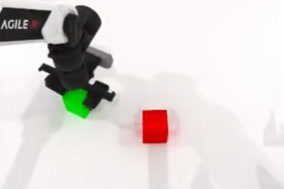
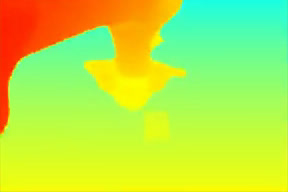
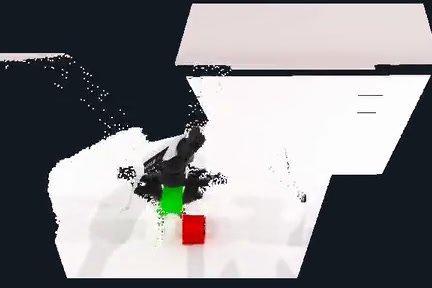
Real E0.5 output on the RoboTwin task stack_blocks_two: holding the green block, it predicts that the arm will soon be over the red block. The actions come from the same features.
E0.5 is post-trained on a dual-arm AgileX Piper and on the Zerith H1 dual-arm humanoid, with a head camera and two wrist cameras. Each video shows the third-person view alongside the three policy camera streams.
10 trials per policy, task, setting and platform. "No pretrain" compares E0.5 against Gemma-initialized π0.5; "pretrained" compares E0.5 pretrained on AgiBotWorld-Beta against the official π0.5-base checkpoint. OOD uses larger trash sets with unseen objects, unfamiliar chargers and cables, and unseen mouse poses. Completion score: charger body 0.25 + full cable 0.75; trash scored k/N.
During training, the backbone has to predict the scene's geometry at the end of each action chunk, a short way into the future. Its features therefore encode how the scene is about to change, and the action expert reads those features at every layer. At deployment only the action path runs.
Implementation details (encoders, attention layout, adapters, loss weights) are in the method section of the technical report. Open the full architecture figure ↗
Pick any of the 50 RoboTwin tasks and compare the depth and point clouds E0.5 predicts for its head and wrist cameras with what actually happened.
Each video is the first training trajectory of its task, not picked by quality; predictions are shown without alignment. Depth uses scene-normalized units. Point colors come from the real RGB frame for display only; E0.5 does not generate images.
Under the same training budget, supervising the backbone with future geometry raises mean RoboTwin success from 46.53% to 55.96%. Reconstructing only the current scene reaches 48.03%.
Trained on 50 clean demonstrations per task, then evaluated in clean scenes and in domain-randomized scenes it never saw during training.
No clean clip for this task
No randomized clip for this task
Clips are selected successful episodes shown from the head camera; they illustrate behavior, while the numbers above are success rates over all trials. Twelve tasks have no randomized clip and turn_switch has none yet.
With no embodied pretraining at all, E0.5 averages 70.0% across clean and randomized scenes. That is higher than π0.5, 4D-WAM and GigaBrain-0.7, which pretrain on 10,000 to 37,000 hours of robot data.
x = hours of embodied pretraining (0 = none). y = mean of clean and randomized success. Hover a point for details.
Success rate (%), macro-averaged over 50 tasks. Params = policy parameters in billions. Pretrain = embodied pretraining data (– = not reported; ✗ = none). Baseline numbers as reported in the E0.5 technical report.
@article{lai2026e05,
  title   = {E0.5: From Reconstructive to Future-Predictive 3D Foundations
             for Robotic World-Action Modeling},
  author  = {Lai, Jianhao and Zhan, Zhihao and Liao, Zhiquan and Li, Qichang and
             Chen, Shubin and Liu, Zhiyuan and Lei, Hongsen and Lin, Jianman and
             Xu, Zhihua and Lin, Xiaoxin and Gong, Ke and Gu, Baiyue and
             Chen, Shiming and He, Junlin and Yang, Longqi and Xiao, Junrong and
             Luo, Haolin and Su, Xiaojuan and Li, Jianfeng and Luo, Yu and
             Sun, Xu and Zhang, Likui and Zhang, Jusheng and Lyu, Qinhan and
             Chen, Tianshui and Lin, Liang and Wang, Guangrun},
  journal = {arXiv preprint arXiv:2610.36011},
  year    = {2026}
}
From future physical structure to embodied action. E0.5 is part of X-Era.AI's work on world-action models.
Read the technical report ↗